Start an electric-bill checkup with energy use, billing dates, and the rate structure, then look at the total charge. A bill can rise because you used more electricity, paid more per unit, had more billing days, or received charges and adjustments unrelated to a change in appliance efficiency.
Keep those explanations separate before deciding what to replace. Your bill is a useful whole-home record, but it does not identify the exact appliance responsible for every change.
Find the period the bill actually covers
Read the service start and end dates rather than using the month printed at the top as the entire time reference. A bill issued in August may include days from July, and consecutive bills may not cover the same number of days.
Record the billing-day count shown by the utility, or confirm how it counts days if you need to calculate it. Do not subtract dates casually and then mix your own count with a different utility convention without checking.
Note whether the meter reading is actual, estimated, adjusted, or described in another way by your provider. An estimated bill followed by a correction can produce a jump that does not mean the house suddenly began using electricity at that rate.
Keep at least several previous bills if available, and use a full year for a broader seasonal view. One unusually hot or cold period is meaningful context, while a single month cannot establish a dependable annual baseline.
Separate power from energy
The EIA explains that watts describe power at a moment, while watt-hours and kilowatt-hours describe energy used over time.
Write the unit every time you copy a number into your notes. A missing “h” can turn a sensible calculation into a comparison between different quantities, especially when a bill and an appliance monitor use similar-looking abbreviations.
For a simple constant-load illustration, 100 watts running for 10 hours corresponds to one kilowatt-hour. That is arithmetic for a stated example, not a claim that a cycling appliance draws its nameplate power continuously or that your actual device uses exactly that amount.
If your utility includes demand charges, time-of-use periods, or other specialized fields, read its tariff explanation. Do not treat every kW or peak-period line as though it were another name for total monthly kWh.

Compare daily use before comparing monthly totals
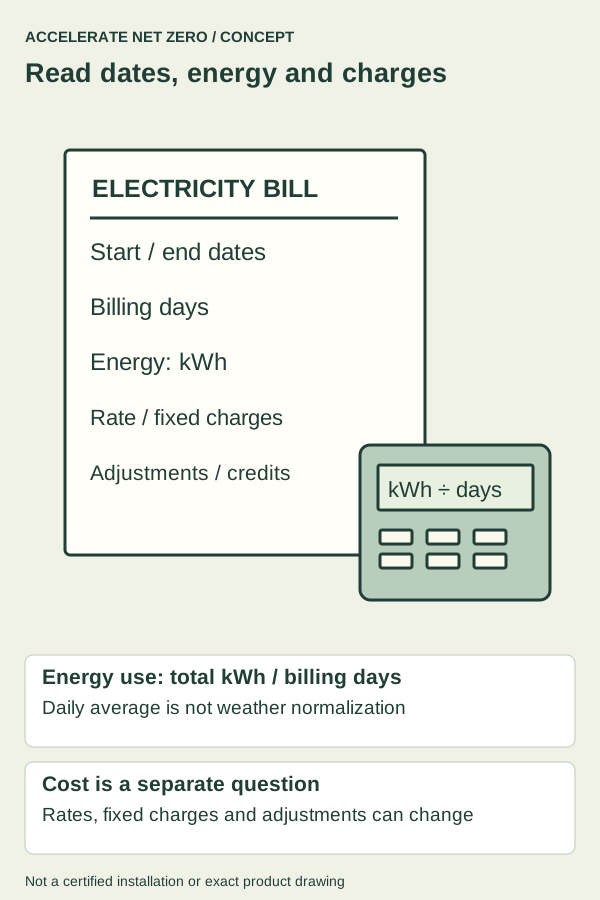
Divide the billed kWh by the billing-day count to get an average kWh per day for that period. This helps remove one simple mismatch between bills of different lengths, while leaving weather, occupancy, and equipment changes to be considered separately.
For an illustrative pair, 600 kWh over 30 days and 660 kWh over 33 days both average 20 kWh per day. The second total is larger, but this calculation alone does not show a higher daily rate of use.
Do not call that a weather-normalized result or a measure of efficiency. A daily average remains a household-use measure for those days, and the home may have faced different heating, cooling, hot-water, or occupancy conditions.
If you compare with the same period last year, attach notes about unusual absences, added equipment, electric-vehicle charging, home working, or fuel changes. A useful comparison keeps those changes visible instead of attributing the whole difference to a new appliance.
Read the charge structure in pieces
Find the energy-related charges, delivery charges, fixed customer charges, taxes, adjustments, credits, and any separate supply arrangement. Your provider may use different names, so use its explanation rather than forcing the bill into another utility's format.
Keep the total dollars and total kWh in separate columns. If dollars increase while kWh stays similar, rates or other charges deserve attention before you conclude that the house has become less efficient.
A simple total-bill divided by total-kWh figure can be useful as a historical average cost, but label it accordingly. It includes fixed charges and other items, so it may not be the marginal price relevant to one extra appliance cycle.
For time-of-use billing, timing matters as well as total use. Ask how the periods and charges work before estimating the cost of shifting an activity, and do not assume an app's default electricity price matches your actual plan.
Treat solar and credits carefully
If the home has solar, read how the bill distinguishes grid imports, exports, credits, and any banked balance. Net billed use can differ from total household consumption, so a small net number does not necessarily describe all the electricity used in the home.
Use the utility's explanation and relevant system records to understand the boundary of each figure. Do not subtract production and exports in a way that counts the same energy twice or assume the bill alone measures everything consumed behind the meter.
Keep one-time credits, annual settlements, and billing corrections separate from ordinary operating charges. Otherwise a favorable adjustment can look like an appliance improvement, or a settlement can look like a sudden failure of the home's efficiency.
If the fields remain unclear, ask the utility to explain a specific line using your bill's dates and labels. You can make the question useful while removing account numbers and other sensitive information from anything shared publicly.
Use interval data as a clue
Some utilities provide daily or shorter-interval use through an account portal. If available, compare the timing with ordinary household events while checking the interval, time zone, completeness, and any delay in the data.
A repeating evening rise may suggest questions about cooking, charging, cooling, or other activity, but it does not identify a single appliance automatically. Keep the description factual until a suitable measurement or professional investigation supports a more specific explanation.
Do not enter an electrical panel or connect measurement hardware to hardwired equipment as a bill-reading task. For a compatible plug-in appliance, a properly rated monitor used according to both devices' instructions may answer a narrower question, with the supply arrangement and safety limits checked first.
Never insert a monitor into a heater's supply path just because you want an energy number. Follow the appliance instructions, including direct-wall requirements, and choose professional measurement when the intended load or connection falls outside ordinary permitted use.
Turn the review into one focused next step
Imagine the total bill rose while average daily kWh remained similar, and the utility changed its rate. The next useful step is to understand that charge change, rather than replacing a refrigerator based only on the larger dollar total.
In another home, daily use rises after a new charging routine begins during the same season. Record that event and examine available data before declaring that the HVAC system caused the entire increase.
Create a short summary with the date ranges, days, kWh, daily average, relevant charge changes, and household events. Keep guesses in a separate note so a future assessment can distinguish the raw record from your interpretation.
Revisit the same fields after an upgrade, with weather and use differences acknowledged. A bill checkup helps you ask better questions and track outcomes, while reliable savings claims require a fair comparison that goes beyond two total-dollar figures.
Keep an untouched copy of the original bill beside the small comparison sheet so you can trace a copied number back to its label. If a later utility adjustment changes the period, add the correction as a new note rather than silently rewriting the history you used for an earlier decision.
For a shared meter, establish which spaces and occupants it serves before comparing your use with another household. Your bill may include a detached workspace, shared laundry, or another agreed load, and that boundary should remain explicit in any assessment or appliance-investigation request.
Sources & further reading
- EIA: Measuring Electricity — Reference for the units used in this guide.
- PG&E: SmartMeter Meter Reading and FAQ — Independent utility primary document explains kW power, kWh energy and billed/metered energy units.
Sources checked October 24, 2026. Product details can change; confirm the exact model and listing before purchase.