Build a home energy plan around the problems you have observed, the work that depends on other work, and the decisions you need to make before equipment fails. A staged plan helps you spend attention and money in a sensible sequence without pretending every home needs the same project list.
Begin with safety, water, and maintenance concerns, then use evidence to prioritize comfort and efficiency improvements. Keep hoped-for savings separate from verified results so the plan remains useful when prices, weather, or household needs change.
Make an inventory with a purpose
List the major systems and building areas relevant to your concerns: heating and cooling, hot water, ventilation, accessible insulation, windows and doors, and significant appliances. Use records and normal accessible observations rather than entering hazardous spaces or opening equipment to complete a spreadsheet.
Add known age or installation dates only where you have evidence, and mark unknowns plainly. An uncertain age can prompt a document search or service question without becoming a reason to replace equipment based on an invented date.
Beside each item, write the actual issue or decision: recurring dampness, a room complaint, maintenance due, a planned renovation, or a unit nearing a replacement decision. This keeps the inventory from turning into a shopping list for products that do not address a clear need.
Include property constraints such as rental permission, shared systems, historic requirements, or limited installation space. A technically appealing project still needs to fit the building and the authority you have to change it.
Put urgent conditions in their own lane
Act on active leaks, unsafe electrical conditions, suspected combustion hazards, and other immediate problems through the appropriate qualified help. Do not leave them buried beneath a future efficiency project or wait for an annual planning exercise to finish.
DOE's whole-house weatherization approach considers the home as a system and addresses relevant health, safety, and water concerns alongside energy work. Use that principle to avoid covering a damp assembly with insulation or changing air leakage without considering ventilation.
Write the responsible person and next action for each urgent item, with a clear status such as awaiting inspection or repair arranged. An item is not resolved merely because someone provided an estimate or because its symptom temporarily disappeared.
Keep maintenance separate from upgrades as well. Replacing an approved filter or arranging normal service may be sensible even while a larger design decision remains open, and it should not be represented as a complete renovation of the system.

Create an evidence folder you will actually use
Gather recent bills, equipment model information, service records, assessment findings, and a few dated photographs of relevant conditions. Remove sensitive account details from material shared beyond the service relationship, and keep original records organized by system or project.
For a room complaint, include a short log with sensor location, time, settings, weather context, and household events. For a bill concern, separate billing days, kWh, rates, and total charges before assuming an appliance is responsible.
Mark the difference between an observation, a professional finding, and a proposal. “Room warmer after lunch,” “measured distribution issue,” and “contractor suggests a duct change” are three different stages of evidence rather than interchangeable descriptions.
You do not need a perfect whole-home dataset before making progress. A focused record that answers the next decision is more useful than months of unstructured screenshots that never become a clear question.
Draw the dependencies before setting dates
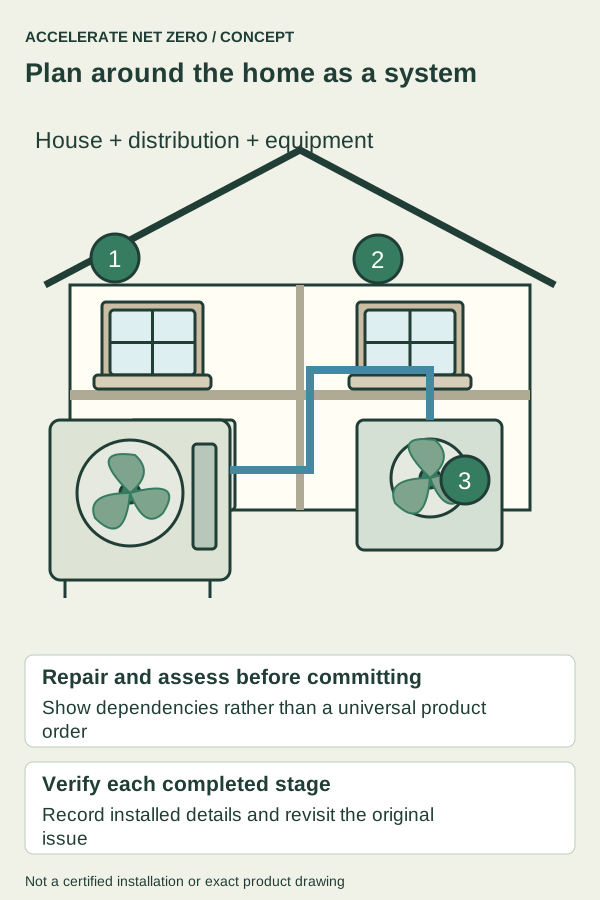
Ask which work must happen before other work and which decisions could change the design. For example, a substantial enclosure improvement may affect a later heating-and-cooling load calculation, while a planned siding project may create access for coordinated building work.
An electrical review may be needed before choosing certain equipment, and drainage or space constraints may affect a water-heater proposal. Keep those dependencies visible so a product purchase does not commit you to an installation that has not been evaluated.
Do not assume every project follows the same envelope-first timeline regardless of the building's condition. An urgent failed heating system and a carefully scheduled renovation require different practical responses, even while both benefit from understanding future work.
Have the responsible professionals explain how the staged approach avoids rework. You want a sequence that fits your home, with temporary arrangements and future interfaces understood rather than an abstract ideal that cannot serve the household now.
Define the next stage by a deliverable
Instead of writing “improve HVAC,” write a concrete next result such as a documented diagnosis of the warm bedroom or comparable replacement scopes based on a load calculation. That gives the stage an end point you can review before committing to installation.
For air sealing and insulation, the deliverable might be an assessment and location-specific scope with ventilation and safety considerations identified. For water heating, it might be a confirmed installation layout, capacity rationale, electrical review, and condensate plan.
Keep research tasks small enough to finish: locate the manual, confirm a model, request a missing scope detail, or compare two exact labels. A broad instruction to investigate everything can delay useful action indefinitely.
Assign an owner and a sensible review date for each next step, while leaving the installation date provisional until the requirements are clear. You are scheduling decisions as well as work, and those are not always ready at the same time.
Compare cost and benefit without invented certainty
Request complete installed scopes so prices include the work necessary for the proposed result. Separate equipment, installation, required supporting trades, permits, exclusions, maintenance, and any follow-up testing you need to understand the full commitment.
If energy savings are estimated, keep the baseline, energy rates, weather assumptions, and model limitations attached. Do not add overlapping project savings as though they are independent, because one improvement can change the load another system serves.
Record comfort, water control, serviceability, and addressing a known defect as benefits in their own terms. They can matter even when you cannot convert them into a reliable annual dollar figure.
Verify current rebates, financing terms, or other program support for the exact project and location before including them in an affordability decision. Keep the underlying project cost visible so an unconfirmed incentive does not silently become money you already have.
Leave room for failure and changing needs
Identify equipment that would force a fast decision if it failed, and prepare a shortlist of suitable approaches in advance. That preparation can include installation constraints and qualified service contacts without requiring you to replace working equipment immediately.
Keep an alternative path if a preferred project cannot proceed because of access, cost, or a newly discovered condition. A good plan records why an item was deferred and what information would allow it to move forward.
Review the plan after major household changes, a renovation decision, or new assessment findings. A growing household, different working pattern, or fuel change can alter priorities without making the original planning effort wasted.
Avoid filling the schedule with product upgrades simply to keep momentum. Sometimes the next useful result is a clearer diagnosis or repair of a water problem, which can prevent an expensive project from addressing the wrong cause.
Verify the result before closing the stage
After work, collect the installed model information, relevant verification records, owner instructions, and the final scope. Revisit the original concern under reasonably comparable conditions and report anything that remains unresolved.
For bill comparisons, acknowledge weather, billing days, rates, and use changes rather than comparing two total charges and declaring a precise saving. For comfort, return to the affected room and time instead of relying only on a normal thermostat display.
Keep the plan short enough to maintain: current concern, evidence, dependency, next deliverable, owner, and status are a strong starting set. A staged energy plan succeeds when each completed step improves the next decision and leaves you with a home whose systems you understand better.
Sources & further reading
- DOE: Whole-House Weatherization — Home systems interact; relevant water and safety issues precede covering work.
Sources checked October 24, 2026. Product details can change; confirm the exact model and listing before purchase.